The Same Laws. A Different Perspective.
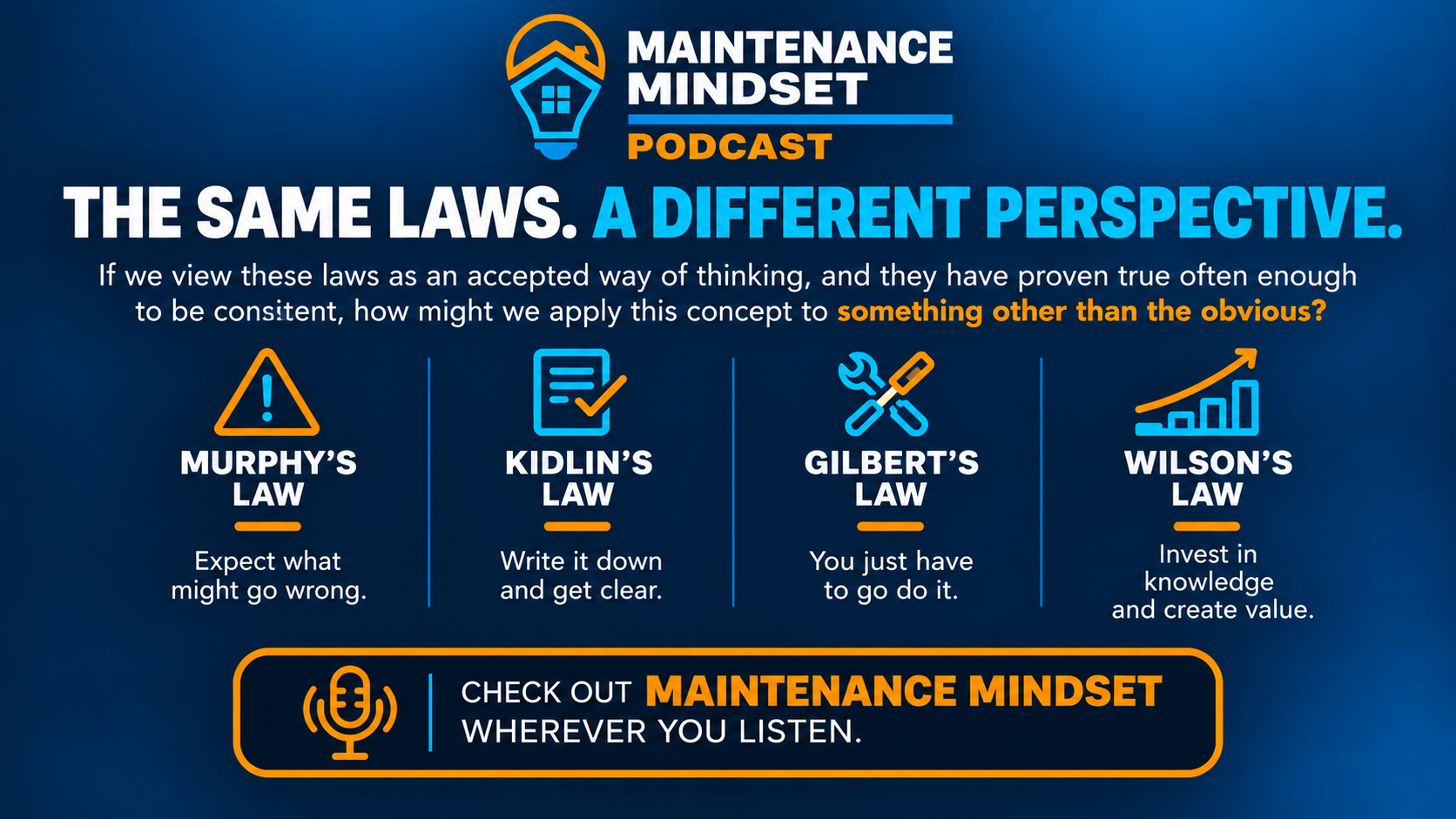
What Murphy’s, Kidlin’s, Gilbert’s, and Wilson’s Laws Can Teach Us About the Maintenance Mindset
In an industry built around solving problems, responding to emergencies, maintaining buildings, and keeping communities running, it's easy to become so focused on what needs to be done that we overlook how we think about doing it.
But what if changing the way we approach a problem could be just as valuable as knowing how to fix it?
That's the idea behind a recent four-episode series of the Maintenance Mindset podcast, hosted by Paul Rhodes.
Across four conversations, Paul explores Murphy's Law, Kidlin's Law, Gilbert's Law, and Wilson's Law—not simply as familiar sayings or philosophical principles, but as opportunities to challenge conventional thinking within multifamily maintenance.
Each law offers a different perspective. Together, they reveal something bigger
Great maintenance professionals don't just develop technical skills. They develop the ability to think ahead, define problems, learn through experience, and turn knowledge into wisdom.
And that mindset has implications far beyond the maintenance shop.
Murphy's Law: Preparation Is a Form of Respect
"Anything that can go wrong will."
Most people associate Murphy's Law with bad luck. Something breaks at the worst possible moment. A simple repair becomes complicated. The one thing nobody expected to fail does exactly that.
But Paul challenges listeners to look at Murphy's Law differently.
What if it isn't a prediction of inevitable failure, but a reminder to prepare for the possibility of failure?
In the episode, Paul shares a childhood memory of working with his father at a table saw. After tying a T-shirt around his face to protect himself from sawdust, his father pointed out the danger of having loose fabric near a spinning saw blade.
That moment became an early lesson in anticipating consequences rather than simply reacting to them.
Paul carries that lesson into the maintenance world, particularly when discussing electrical safety.
He emphasizes the importance of understanding testing equipment, respecting electrical hazards, following lockout/tagout procedures, and verifying that equipment is safe before beginning repairs.
The takeaway isn't to approach every task afraid of what might happen.
It's to approach every task with enough respect for what could happen that we take the necessary precautions.
The maintenance mindset connection: Preparation isn't pessimism. It's professionalism.
For multifamily maintenance teams, that perspective can influence everything from preventive maintenance schedules and equipment inspections to emergency preparedness and daily safety practices.
Kidlin's Law: Clarity Comes Before Action
"If you write the problem down clearly, then the matter is half solved."
Multifamily maintenance professionals are problem-solvers by nature.
A work order comes in, a resident calls, a piece of equipment fails, and the instinct is to jump into action.
And sometimes, particularly when life safety or significant property damage is involved, immediate action is absolutely necessary.
But outside of those emergencies, Paul encourages maintenance professionals to reconsider the value of slowing down long enough to clearly define the problem.
In the Kidlin's Law episode, he uses seasonal maintenance planning as an example.
It's easy to tell a team to "get ready for winter."
But what does that actually mean?
Does it mean purchasing ice melt? Inspecting heating equipment? Preparing snow removal equipment? Checking vulnerable plumbing? Evaluating water heaters? Reviewing last year's challenges?
Without clearly defining the objective, a team can stay busy without necessarily accomplishing what matters most.
Paul also challenges listeners to think beyond vague goals like reducing outstanding work orders.
Reducing a backlog from 100 to 98 technically accomplishes that objective. But is that really what success looks like?
A clearly defined goal establishes not just what needs to happen, but how success will be measured.
And writing it down creates something equally valuable: a record that can be revisited, evaluated, and improved.
The maintenance mindset connection: Being busy isn't the same as being effective.
Gilbert's Law: Knowledge Means Little Without Application
"The biggest problem with any task or job is that no one tells you exactly what it is or how to do it."
Training is essential in multifamily maintenance.
Technicians need to understand systems, equipment, procedures, and safety requirements. They need access to education, resources, and knowledgeable instructors.
But as Paul explains through Gilbert's Law, there's a limitation to what instruction alone can accomplish.
At some point, you have to actually do the work.
Using HVAC brazing as an example, Paul explores the difference between understanding a process and developing the physical skill required to perform it correctly.
A technician can read about brazing, watch instructional videos, study the equipment, and understand the theory.
But none of that replaces the experience of practicing the skill.
It's through repetition that knowledge becomes practical ability. Whether it's brazing, drywall repair, appliance troubleshooting, or another technical skill, proficiency develops through repeated application.
Paul also makes an important point about seasonal skills. If a technician only practices a particular repair when the need arises, valuable time may be spent relearning something that could have been maintained through intentional practice.
The maintenance mindset connection: Training provides the foundation. Practice develops proficiency.
Gilbert's Law challenges the idea that training is complete once someone attends a class, earns a certification, or watches a demonstration.
Real development requires opportunities to practice, make connections, build confidence, and apply what has been learned in the physical world.
Wilson's Law: Knowledge Creates Value, but Wisdom Makes the Difference
"Prioritizing knowledge and intelligence will lead to financial success."
Of the four laws, Wilson's Law may offer the most significant challenge to how the multifamily industry thinks about maintenance careers.
Traditionally, career advancement in maintenance has often been measured through promotions, titles, and compensation.
But Paul raises an important question:
Are we developing maintenance professionals for long-term career success, or simply moving them into different roles because that's the only way to recognize their value?
In the episode, he discusses the tendency to promote experienced technicians into supervisory positions without necessarily preparing them for leadership responsibilities.
Technical proficiency and leadership ability aren't automatically the same thing.
A great technician may understand equipment, troubleshooting, and repairs exceptionally well. But supervising a team also requires communication, delegation, decision-making, and people-development skills.
Those capabilities need to be cultivated intentionally.
Paul also explores the growing role of artificial intelligence and automation, questioning what happens when organizations begin replacing opportunities for foundational learning with technology.
While technology can process information and perform repetitive functions, he emphasizes the importance of human experience, creativity, judgment, and the relationships maintenance professionals build with residents.
This leads to Paul's proposed evolution of Wilson's Law.
Rather than focusing exclusively on knowledge and intellect, he argues that the real opportunity lies in wisdom—the application of knowledge.
Knowing something is valuable.
Knowing when, why, and how to apply it in a real-world situation creates a different level of value.
The maintenance mindset connection: Career growth shouldn't be accidental, and professional value shouldn't be measured by job title alone.
For multifamily leaders, this means creating intentional development opportunities that extend beyond technical training.
For maintenance professionals, it means recognizing that every experience, every skill, and every opportunity to solve a problem can contribute to a lifelong career.
Four Laws. One Bigger Lesson.
Missed an Episode? Go Back and Experience the Full Series.
Murphy's Law
Check out Maintenance Mindset wherever you listen to podcasts, and discover what a different perspective can bring to your maintenance career.
Recent Posts